Is a single genetic test result the end of the diagnostic journey?
At 3billion, we believe diagnosis is an ongoing process. That’s why we focus not only on the test itself, but on what comes after:
Reanalysis.
For all cases previously reported as Inconclusive or Negative,
3billion performs automated reanalysis through a continuous system.
Each month, dozens of reports are updated, revealing new diagnostic insights and possibilities.
Summary of Diagnostic Changes This Month
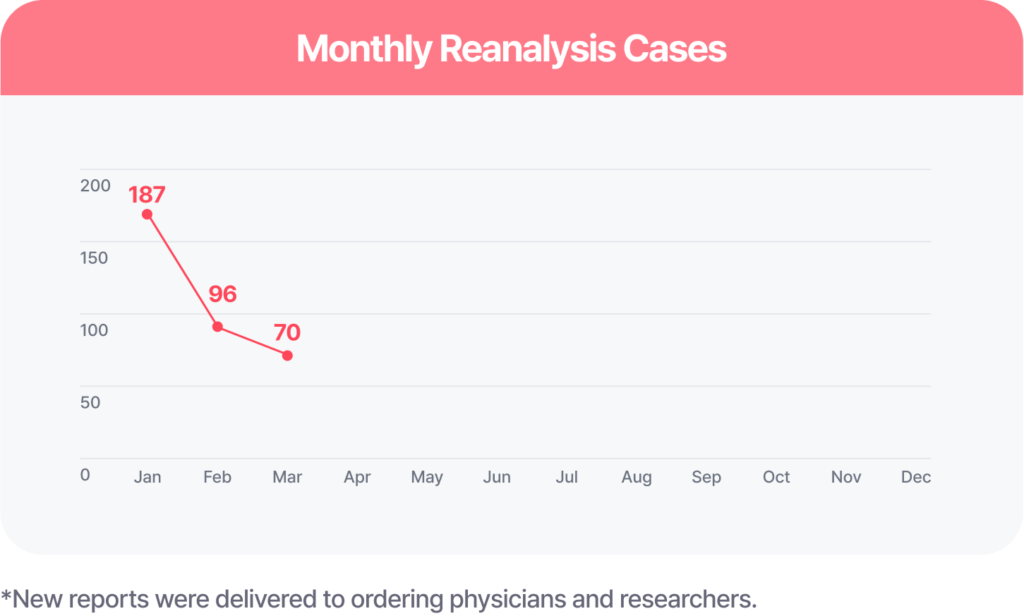
In March 2026, a total of 70 patients received updated reports through reanalysis.
Why did the results change?
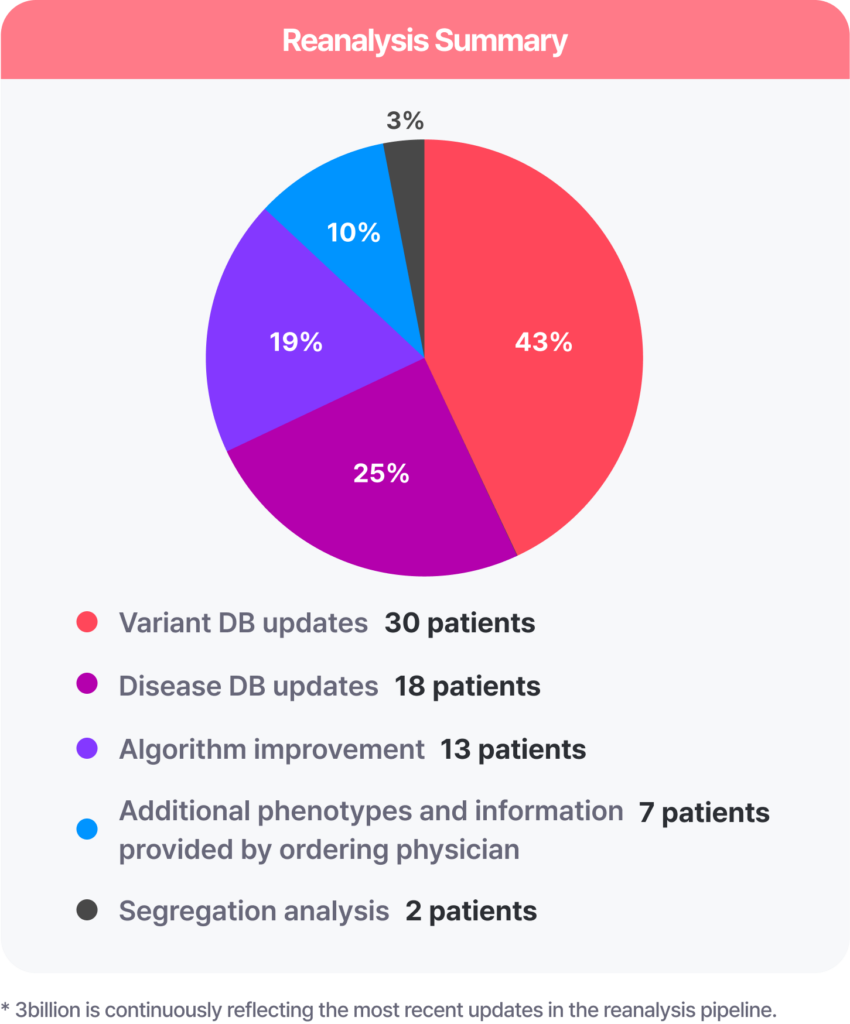
- 43%: Variant database updates
- 25%: Disease database updates
- 19%: Algorithm improvement
- 10%: Additional clinical or phenotype data
- 3%: Segregation analysis
📍This means that as clinical and scientific data evolve, the same patient data can lead to a different diagnosis over time.
Let’s take a look at a real-world case where reanalysis led to a new result through a variant database update.
💡 The Power of Reanalysis: A Real Case
In March 2026, genetic testing identified two variants in a patient. The first variant was confirmed as Pathogenic, while the second (NM_001282225.2:c.140G>A) was classified as a Variant of Uncertain Significance (VUS). Since both variants needed to be pathogenic for a diagnosis, the initial report was issued as Inconclusive.
About ten days later, the automated reanalysis system detected a data update for the same variant. Upon internal review, the variant was reclassified as Likely Pathogenic (LP), and the patient’s report was updated to Positive.
As this case illustrates, a reanalysis system is essential for keeping pace with constantly evolving databases. 3billion automates this process to deliver results faster and at a more accessible cost.
So, how exactly does automated reanalysis work?
It continuously monitors the latest variant and disease databases, updates internal interpretation models, and incorporates new phenotype and family history data submitted by clinicians.
Diagnosis doesn’t end with a single report.
It continues as the knowledge base grows— and 3billion’s automated reanalysis system ensures patients benefit from that progress.
답글 남기기
댓글을 달기 위해서는 로그인해야합니다.