This series focuses on what human interpreters truly need to understand and judge after automated prioritization, in an era where AI-based variant interpretation tools have become commonplace.
Each episode centers on a specific disease group, exploring both the underlying genetic mechanisms and the clinical spectrum, and aims to share perspectives needed to move beyond simply “finding” variants toward meaningfully explaining and interpreting them.
Episode 0 — Beyond the Variant
📌 Series Introduction
In an era where AI-based variant interpretation tools have become standard in clinical genomics, this series focuses on what happens after automated prioritization— what human interpreters still need to understand, evaluate, and decide.
Each episode centers on a specific disease group, examining its genetic mechanisms and clinical spectrum together, with the goal of moving beyond simply “finding variants” toward explaining and interpreting them in a clinically meaningful way.
Interpretation tools have evolved, but the final judgment is still human
Over the past few years, the landscape of variant interpretation has changed rapidly.
AI-driven variant prioritization, phenotype-based matching, and automated ACMG classification are now part of routine workflows in many diagnostic laboratories.
With tools like GEBRA, interpreters can review prioritized variant candidates at a glance and assess their similarity to a patient’s clinical presentation far more intuitively than before.
These tools significantly reduce repetitive workload and allow analysts to focus on higher-level decision-making, greatly improving overall efficiency.
Yet no matter how advanced these tools become, one final question always remains in variant interpretation:
“Why —and based on what evidence — can we say that this variant explains the patient’s disease?”
This question cannot be answered by model performance alone.
Arriving at an interpretable and defensible conclusion still requires the integration of genetic evidence, clinical context, and previously reported cases— a process that still fundamentally depends on human expertise.
At 3billion, our internal experts do not simply accept automatically suggested candidates.
Instead, they carefully review each variant, evaluate its relevance in context, and select the most convincing causative variant to support the final clinical report.
Beyond software: when interpreter expertise grows alongside the tools

Through repeated interpretation work, one insight has become increasingly clear.
While software support is essential, its impact is maximized only when paired with the interpreter’s own understanding and experience.
As disease-specific knowledge accumulates, the depth of variant interpretation changes accordingly.
Even when reviewing the same list of candidate variants, an interpreter who understands the disease’s molecular mechanisms, clinical spectrum, and previously reported variants can reach conclusions that are both more accurate and more confident.
In an era where AI handles much of the analytical workload, the role of the human interpreter is no longer just to confirm results, but to explain the rationale behind decisions and justify interpretations in a transparent way.
Why genetic diseases are difficult: heterogeneity
Genetic diseases are inherently heterogeneous.
A single clinical diagnosis may be caused by many different genes, while a single gene may give rise to a broad spectrum of clinical presentations.
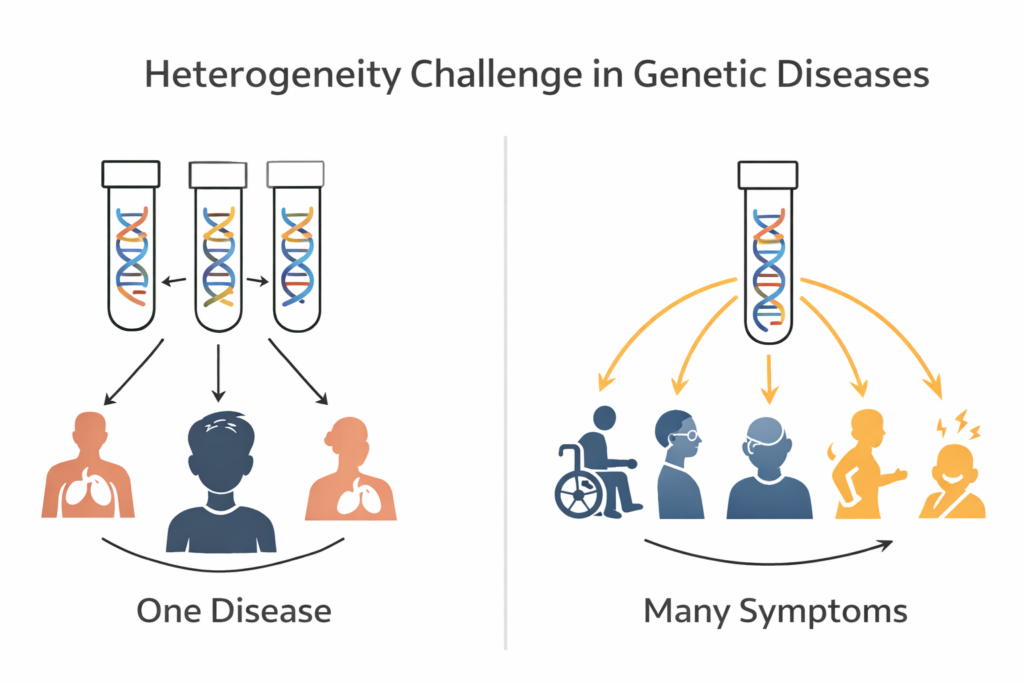
Because of this complexity, blindly following AI-generated rankings can sometimes lead to missed clues.
That is why we started this disease-focused series
Within 3billion, we have been continuously addressing these challenges through structured, disease-specific learning and internal review.
Over time, a natural question emerged:
“Is this really just our internal challenge,
or are external users facing the same difficulties?”
That question led us to this series.
By selecting one disease group at a time, we aim to organize and share key genes, molecular mechanisms, and clinical characteristics in a structured and accessible format.
This article is not about a specific disease.
Rather, it explains the perspective from which this series approaches genetic interpretation.
Starting with the next episode, we will explore individual disease groups in detail,and consider how AI-generated results can be translated into clear, interpretable clinical reasoning.
답글 남기기
댓글을 달기 위해서는 로그인해야합니다.