[카테고리:] 블로그 (Blog)
-
![Quantitative Interpretation of ACMG/AMP Variant Classification [Part 1]](http://d15q5w6b9vqac5.cloudfront.net/wp-content/uploads/2024/09/26201306/Siri%EC%8D%B8%EB%84%A4%EC%9D%BC39-1.webp)
Quantitative Interpretation of ACMG/AMP Variant Classification [Part 1]
The ACMG/AMP 2015 guidelines remain the standard framework for interpreting clinical genetic test results.However, in real-world variant curation, situations frequently arise that cannot be fully explained by the predefined combinations in the guidelines. Typical examples include cases where both pathogenic and benign evidence coexist, or where evidence combinations do not clearly fit into the rule-based…
-
ACMG/AMP variant classification, Bayesian에서 point system으로 | 변이 해석 시리즈 [1편]
ACMG/AMP 2015 가이드라인은 현재까지도 임상 유전검사 해석의 표준적인 프레임워크로 사용되고 있습니다.그러나 실제 variant curation 과정에서는 guideline에 제시된 대표 조합만으로 설명하기 어려운 상황이 자주 발생합니다. 병원성을 지지하는 증거와 반대하는 증거가 동시에 존재하거나, 규칙표에 명확히 대응되지 않는 조합이 나타나는 경우가 대표적입니다. 이러한 한계를 보완하기 위한 접근으로 제안된 것이 Tavtigian 등이 2020년에 발표한Fitting a naturally scaled point system…
-

Long-read sequencing compared: PacBio, Oxford , and Illumina
📍Key takeaways 1. Why long-read now? The “dead zone” concept Sequencing reads out the order of the bases — A, T, G, C — that make up DNA. Because a genome is far too long to read end to end in a single pass, every sequencing method cuts the DNA into manageable pieces, reads those…
-
롱리드 시퀀싱 3파전 — PacBio · Oxford Nanopore · Illumina TruPath 총정리
📍Key Takeaways 1. 왜 지금 롱리드인가? “데드존”이라는 핵심 개념 시퀀싱은 DNA의 염기서열(A·T·G·C 순서)을 읽어내는 작업입니다. DNA가 너무 길어 한 번에 다 읽을 수 없기 때문에, 잘게 잘라 조각을 읽은 뒤 다시 이어 붙여 전체를 복원합니다. 이때 “조각을 얼마나 길게 읽느냐” 가 숏리드와 롱리드를 가릅니다. (숏리드, 롱리드 비교 설명 포스트) 쉬운 비유로, 긴 문장을 짧은 단어…
-

Long-Read vs. Short-Read Sequencing: What’s the Difference?
Short-read sequencing analyzes small DNA fragments with very high accuracy, making it a standard for detecting small genetic changes. Long-read sequencing analyzes much larger DNA fragments, which helps to assemble a more complete picture of the genome, especially in complex regions. Long-read technology excels at identifying large structural variants (SVs) and repeat expansions that are…
-
롱리드 시퀀싱과 숏리드 시퀀싱: 무엇이 다를까요?
숏리드 시퀀싱은 작은 DNA 조각을 매우 높은 정확도로 분석하여, 미세한 유전적 변화를 검출하는 표준 검사입니다. 롱리드 시퀀싱은 훨씬 더 큰 DNA 조각을 분석하여, 특히 복잡한 영역에서 유전체의 더 완전한 그림을 조립하는 데 도움을 줍니다. 롱리드 기술은 숏리드 방식으로는 종종 놓치는 큰 구조 변이(SV)와 반복 확장 변이를 식별하는 데 뛰어납니다. ‘진단 방랑’을 겪는 환자들에게 롱리드 시퀀싱은…
-
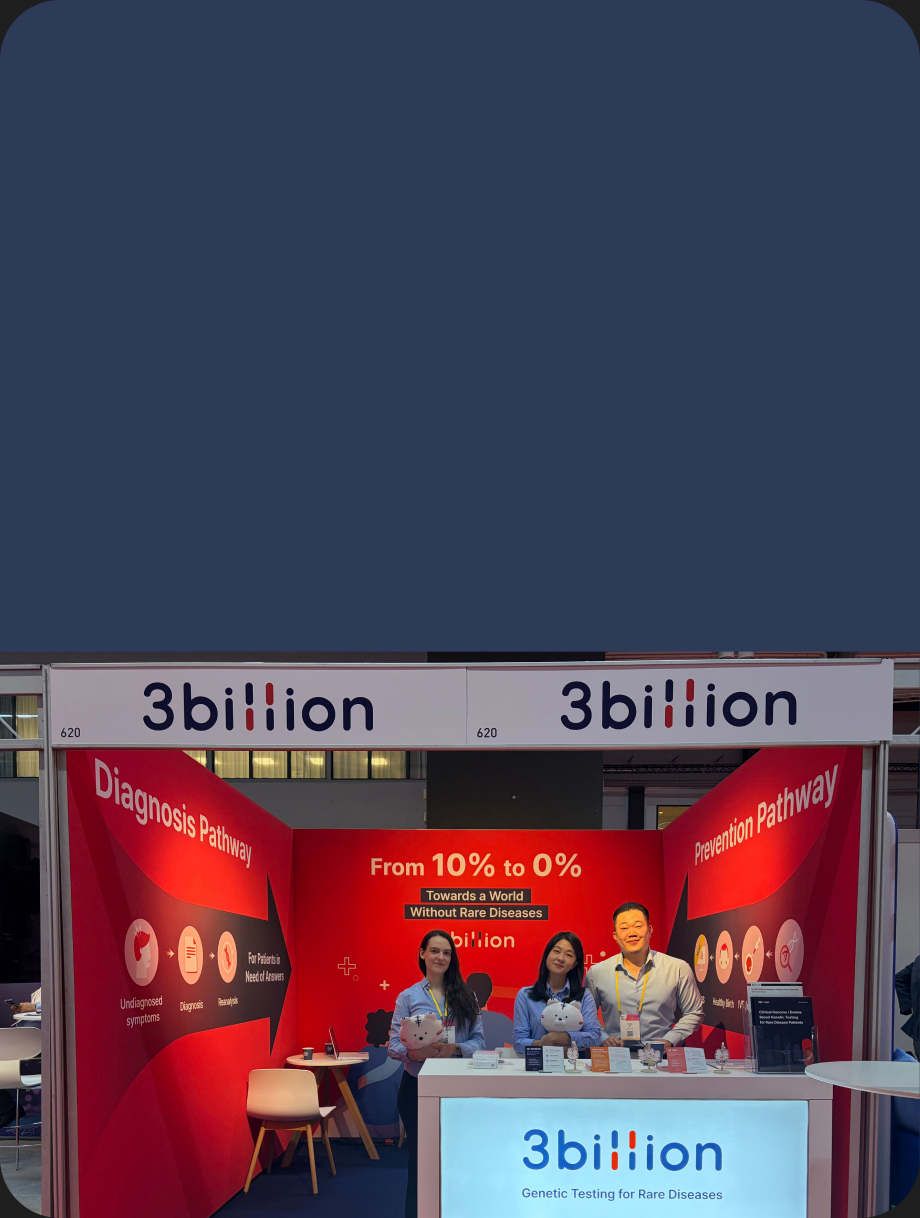
ESHG 2026 Field Report: What Topped the Agenda
ESHG is Europe’s largest genetics conference, drawing researchers, clinical geneticists, and people from across the diagnostics industry — from all over Europe and well beyond. Last year’s conference in Milan brought together 6,881 registrants from 94 countries; the official numbers for 2026 haven’t been released yet. This year’s conference ran June 13–16 in Gothenburg, Sweden.…
-
ESHG 2026 현장 리포트 — 가장 뜨거운 아젠다는 무엇이었나
ESHG는 유럽 최대 규모의 유전학 학회로, 매년 유럽을 넘어 전 세계의 연구자, 임상유전 전문가, 진단 산업 관계자가 한자리에 모이는 곳입니다. 2025년 밀라노에서 열린 ESHG에는 94개국에서 6,881명이 등록했으며, 2026년 공식 수치는 아직 발표 전입니다. 올해 학회는 6월 13–16일 스웨덴 예테보리에서 열렸습니다. 현장에서 3billion팀이 직접 확인한 흐름 가운데, 희귀질환 진단의 방향성을 가장 잘 보여준 두 가지를 골라…
-
![Episode 9: [Sotos Syndrome] What If Your Child Is Unusually Large? Everything About the NSD1 Gene and Overgrowth Syndrome](http://d15q5w6b9vqac5.cloudfront.net/wp-content/uploads/2026/06/12171328/%EC%9E%84%EC%83%81-ep9.png)
Episode 9: [Sotos Syndrome] What If Your Child Is Unusually Large? Everything About the NSD1 Gene and Overgrowth Syndrome
“My child is a bit slow in development, but why are their height and head circumference growing so rapidly?” Many parents naturally assume that if a child grows quickly, it simply means they have “excellent physical development” or have inherited a large build. However, if your child is exceptionally tall, has a large head, and…
-
Episode 9: [소토스 증후군] 아이가 또래보다 유난히 크다면? NSD1 유전자와 과성장 증후군의 모든 것
“우리 아이는 발달이 조금 느린 편인데, 키와 머리둘레는 왜 이렇게 빨리 자랄까요?” 많은 부모님들은 아이의 성장이 빠르면 단순히 “발육이 좋다”고 생각하며 넘어가기 쉽습니다. 하지만 또래에 비해 유난히 키가 크고 머리가 크며 발달이 더디다면, 단순한 체질이 아니라 유전적 과성장 증후군(Overgrowth syndrome)을 의심해 보아야 합니다. 그 대표적인 질환이 바로 소토스 증후군(Sotos syndrome)입니다. 오늘은 1964년 소아내분비학자 칭호를 시작으로…