[태그:] 영문
-

What Does Heterozygous Mean in Your Genetic Report?
Being heterozygous means you inherited two different versions (alleles) of a gene — one from each biological parent. For example, an A blood-type allele from one parent and a B allele from the other. This is a basic building block for understanding how traits are inherited. Whether it affects your health depends on the specific…
-
NIPT for Prenatal, 3B-NEO for Postnatal: Comprehensive Screening from Day One
*Please note that as of the date of this post, 3B-NEO is not yet available in South Korea. During pregnancy, NIPT is the gold standard for protecting your baby before birth. But what happens once your newborn finally arrives? In the first few days of life, hospitals perform routine physical checks and basic newborn blood…
-
Episode 8: Lysosomal Storage Disorders (LSD) — Beyond Variant Interpretation
Key Takeaways 📌 Series Introduction This series is authored by clinical genomics experts at 3billion. In an era where AI-driven variant prioritization tools have become ubiquitous, we focus on what interpreters must critically evaluate and decide after automated prioritization is complete. In each episode, we focus on a specific disease group, exploring both the underlying…
-

Which Children with Motor Speech Disorders Should Be Prioritised for Genetic Testing?
At a Glance When delayed walking (OR 15.96), receptive language impairment, borderline IQ, dysmorphic features, or motor delays are present, exome sequencing should be considered first.A landmark clinical study has finally answered a question families have been asking for years. The clinical genetic diagnostic yield for childhood motor speech disorders (CAS/dysarthria) is 29% — on…
-

Could Your Patient’s Unexplained Joint Dislocations Be EDS? | EDS Awareness Month, May 2026
📍Key Takeaways What Is EDS? Ehlers-Danlos syndrome (EDS) is a group of heritable connective tissue disorders caused by defects in collagen synthesis or structure. Because connective tissue is distributed throughout the body — in joints, skin, blood vessels, and internal organs — symptoms can manifest across multiple organ systems simultaneously. The 2017 International EDS Classification…
-

Episode 7: Prader-Willi and Angelman Syndromes — Beyond the Variant
📌 Series Introduction This series is authored by clinical genetics experts at 3billion. In an era where AI-driven variant prioritization has become commonplace, we focus on what interpreters truly need to understand and how they should exercise clinical judgment after automated tools have done their part. Each episode centers on a specific disease group, exploring…
-
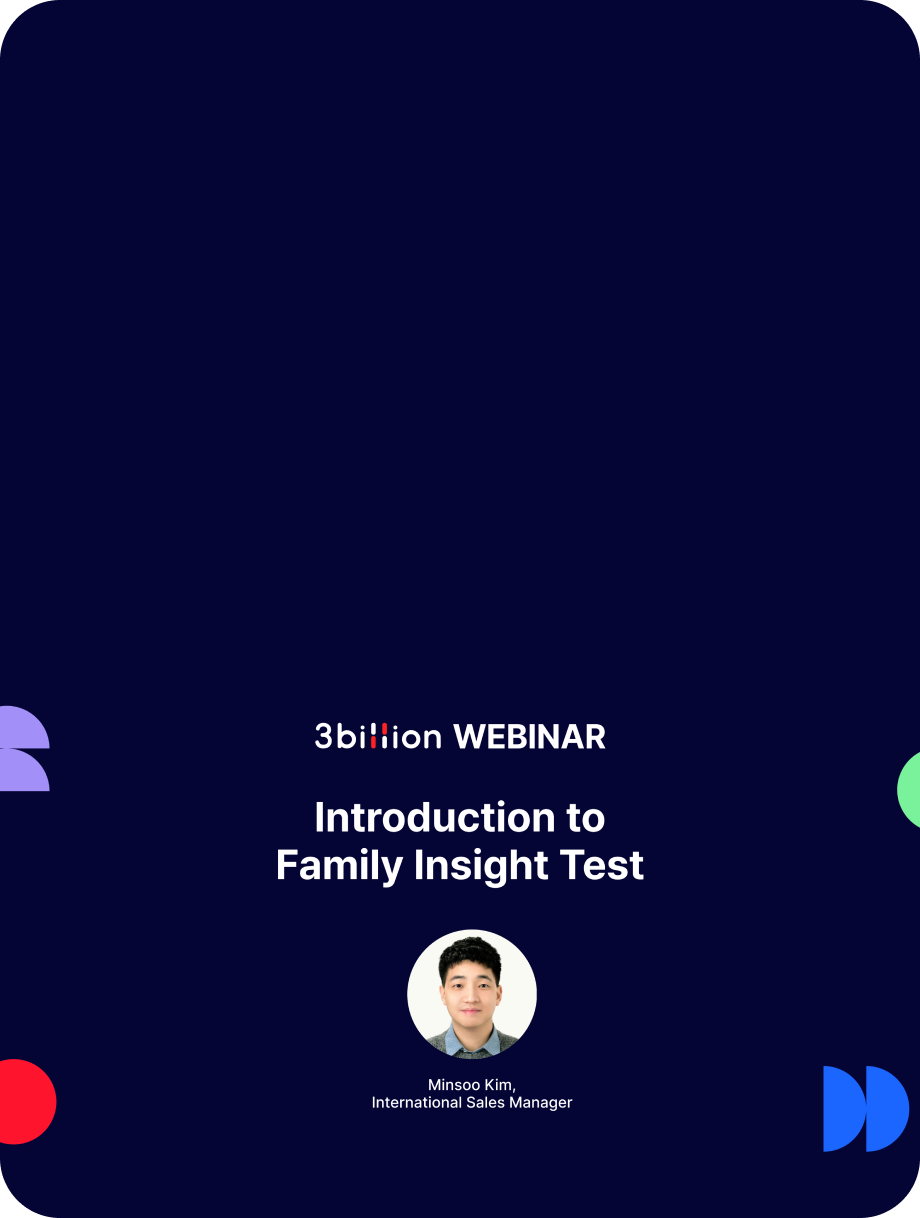
Family Insight Test Webinar: Clarity for Your Family’s Future
Join our webinar to discover how 3billion’s Family Insight Test provides the answers you’ve been searching for. Key Highlights of the Session Ready to Attend? Simply sign up via the button below. We’ll send the YouTube webinar link directly to your inbox.
-

3billion Reports 68% YoY Revenue Growth in Q1: Strengthening Growth Foundation Through New Test Launch
SEOUL, South Korea — 3billion (CEO Changwon Kum), an AI-powered rare disease diagnostics company, announced on the 12th that its consolidated revenue for the first quarter of this year reached KRW 3.36 billion, marking a 68% increase compared to the same period last year. The company reported an operating loss of KRW 1.66 billion and…
-

Treacher Collins Syndrome: Identifying Genetic Causes via Advanced Sequencing
📍Key Takeaways 1. Resolving Genetic Heterogeneity and Inheritance Uncertainty TCS is caused by mutations in TCOF1, POLR1B, POLR1C, or POLR1D. Genetic testing is essential to differentiate between autosomal dominant and recessive inheritance, resolving uncertainties that clinical observation alone cannot address. 2. Enhancing Accuracy in Recurrence Risk Counseling Misclassifying the inheritance pattern based solely on phenotype…